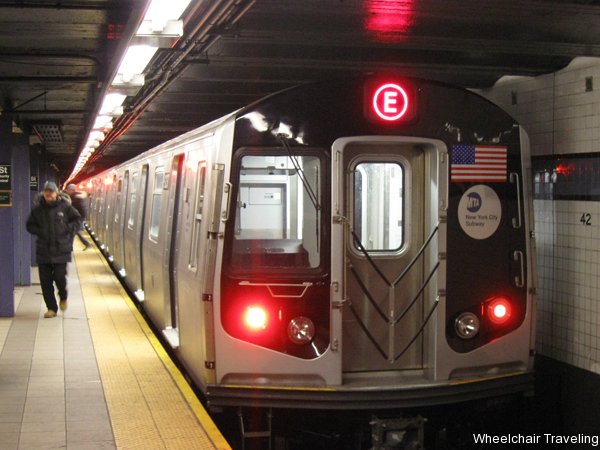
I’m glad I did. It opened up a whole new world of adventures…so long as I wanted to stay within wheeling distance of the accessible Penn Station exit I like to use on 34th Street and 7th Avenue. After a while, I realized that there’s so much more to be seen and so much to do in NYC. So, in order to traverse the city, I had to be bold and take on the subway system, which I used to avoid like the plague. To be honest, using the subway can be quite challenging because it’s not the most wheelchair friendly method of transportation.
“By planning ahead and being prepared, the subway system is an awesome way for people who use wheelchairs to expand opportunities for adventure in New York City. And in a city full of excitement and rich culture, you won’t want to miss a thing!” – Emily Ladau
In some ways, I can understand why the subway isn’t particularly easily accessible. It was developed in the very early 1900s when accessibility wasn’t on the forefront of everyone’s minds. As legislation and social consciousness surrounding disability has improved in the 21st century, the NYC subway system is still lagging behind in many ways. That being said, now that I’ve got some adventures (and, unfortunately, misadventures) with the subway under my belt, I’ve got some insight for visitors who use wheelchairs to get around successfully on the subway.
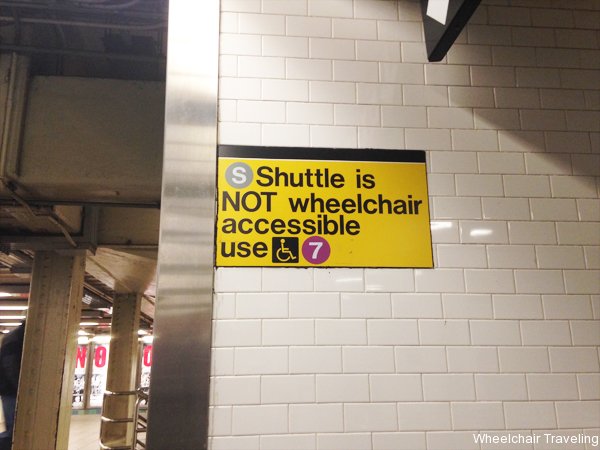
The first and most important lesson I learned about navigating the subway when you’re unfamiliar with it is to research ahead of time. I must confess that I learned this the hard way. When I braved the subway the first couple of times, I was with friends who have a good sense of direction and knowledge of how the subway works, so I was able to rely on them. However, the first time I attempted to use the subway with a group of friends who were as unsure as I was, our plans for the day were completely foiled. We were supposed to see a play but forgot to double-check directions, so we asked a policeman outside the subway for assistance. He gave us directions that involved three different steps including a transfer to a shuttle, and though we were hesitant, we assumed the policeman knew what he was talking about. When we tried to follow the directions we were given, we made it as far as the shuttle only to discover a huge sign announcing that the shuttle is not wheelchair accessible. In the end, the policeman’s unusable directions caused us to miss the play, but we can’t totally blame him.
It’s frustrating that the policeman lacked a basic knowledge of NYC transportation accessibility, but it reminded me of why it is necessary to always verify how to get places beforehand. This is especially important because not every subway stop is accessible or has an elevator. The Metropolitan Transit Authority (MTA) website provides a list of accessible stations. Plus, you’ll want visit the website to make sure the elevators at the stations you need are in working order. I cannot stress enough how crucial it is to use these resources before you venture into the city, because it can make all the difference between a smooth trip or scrambling to alternate your route and plans.
If you or a family member or friend uses a wheelchair, don’t let any of this intimidate you or prevent you from using the subway, because I promise a little forethought goes a long way. It’s worth it for the amazing possibilities that will be opened to you. And once you do your research, you’ll be well on your way. Of course, in order to successfully conquer the subway, there are a few things you can do to strategize and make it easier to get on and off the train cars.
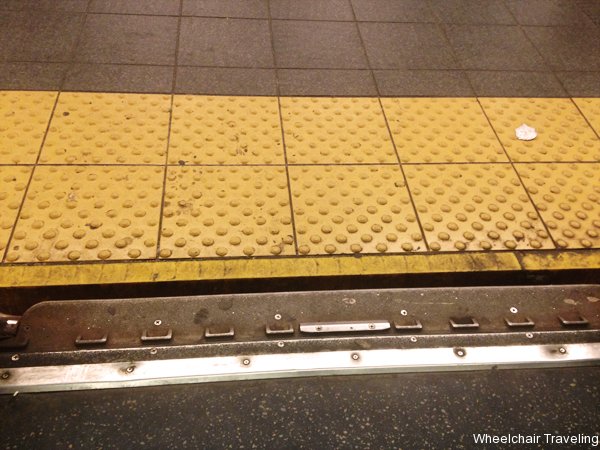
First of all, there will always be a gap between the train and the platform. The size of the gap varies from station to station, but it’s always there. Keep this in mind, because especially when the subways are at their peak usage time, you don’t want to risk getting front caster wheels caught in the gap. (Trust me, I speak from multiple experiences.) If you use a manual wheelchair, I recommend tipping back a bit to get your wheels over the gap. I should note that this doesn’t work for me in my power wheelchair, so I have to be more careful in maneuvering. While this trick is unfortunately not fail proof, I recommend putting your chair on full speed if you can, and gunning it straight forward to get over the gap. Second, while still minding the gap, don’t forget to move quickly because sometimes, the doors open and close in a minute or less.
Third, and perhaps most important, don’t be afraid to ask for assistance, particularly if you’re using the subway for the first time on your own. I’m a staunch advocate for independence, but since I definitely don’t want to get stuck in the gap or between the doors, sometimes I ask other subway patrons to lend a hand and help me get my heavy power wheelchair inside. The best thing to do when asking for help to ensure you get what you need is to show or explain to people exactly where to grab on to your chair to give you a lift.
Everyone else generally will get out of the way. Despite the stereotype that New Yorkers are rude, I assure you that’s absolutely not the case and people are generally happy to assist me. And, once you’re on the subway car, it’s important to know that there are no designated wheelchair areas. If it’s not too crowded, try to get over to the side and away from being in front of the doors. If it’s a peak time, you might have nowhere to move, so you’ll have to squeeze wherever you can fit. Remember, you have just as much of a right to take up space on the subway as everyone else!
About Insane Wayne Insane Wayne is a comedian and speaker based in California, known for…
Accessible cruising can open the door to a memorable and relaxing vacation, but the details…
For many wheelchair users visiting the United States, renting a wheelchair-accessible van can make the…
Travel has long been recognized as a powerful way to experience the world, learn about…
Disclosure: This article highlights products that may be helpful for wheelchair travelers. WheelchairTraveling.com received a…
In late 2024, the U.S. Department of Transportation (DOT) finalized a rule focused on wheelchair…
This website uses cookies.
View Comments
The NYC Mayor's Office on Accessibility has some great resources on Accessible New York (hotels, restaurants, activities). Their staff directed me to the Columbus Street Station because it supposedly has access to more accessible subway lines than anywhere else in the CIty. I don't know about Penn Station, but they were right. We were able to get everywhere from Columbus Circle including Coney Island, Highline (with elevators to wheelchair accessible trail), SoHo and Broadway. Greatful for the sidewalk cafes. One restaurant had the most creative accessible bathroom - a sliding wall that looked like a piece of art until you saw what was behind it. No navigating a small doorway. The online subway system map identifies all the stops that are accessible. We always watched for the wheelchair sign at every stop. If it wasn't there, we went to the next stop. And the people were always helpful at the station and on the train, especially with the gaps between the platform and train. Except for one station where the elevator was not in service, getting around NYC was easier than we expected. I wouldn't recommend the Hells Kitchen area. Every restaurant had steps down. Thanks to my kids, we made it work, but not the best part of town for someone in a wheelchair. We also went to the Helen Hayes Theatre. There accessible seats are front row and you exit with the cast but no accessible men's bathroom. Plan ahead, which we did after talking to the ticket office. No longer scared of going to NYC anymore. We had a great trip.
Susan, I'm so glad to hear you had a successful NYC trip! And what a great tip about the resources from the Mayor's office.
Thank you for this article. I will be visiting NYC for the first time this August and one of my biggest concerns is what a nightmare that I've heard/read that NYC public transportation is.
I live in Los Angeles and while it's not perfect, it seems like this city might do better in that area. I don't know if I will be taking any subways beyond the 7 train but my biggest concern is the gaps I read about. I'm hoping that it won't be too bad.
Thank you again for sharing your advice.
Katherine, thanks for reading my article. I assure you that you'll be able to manage the gaps. The worst that could happen is you may need to ask for a tad bit of assistance. But certainly don't be nervous. There are so many adventures waiting to happen in the city and I'm so glad you're visiting!
I just spent a day in downtown and midtown NYC. I was quite disturbed that the elevators at both stops that I was using were Out of Order. Mobility impaired people were literally crawling up and down the steps.
NYC should do better. It is best to take the bus.
I've only been using a wheelchair for about two years now, but knowing how frantic things can get on the subway after years of riding them, I commend your bravery. When I was still able to walk with canes, I switched to Access A Ride...it was too tiring to manage the stairs and my needed station didn't have an elevator at that time. However, now that I have a power wheelchair, I may decide to try the railroad and subway again, given your experiences. Thank you.
How VERY kind of you to say! It's 100% possible. Don't forget to have patience for yourself and the system itself. Give yourself extra time to figure it all out because sometimes elevators break down or there's other complications.
Thank you for making this! I know this article was written a long time ago so I don’t know if it used to be different, but there are actually specific subway cars without seats and marked for wheelchairs. I live in nyc and have recently started using a mobility aid and so I’ve been doing a lot of research and this is one of the only articles that comes up so I just wanted to let people know. In my experience the last subway car has the smaller sets of seats cleared all the way on the farthest end of of the train for wheelchair users. So you need to know which direction the train is pulling up on the tracks to be able to head to the tail end of it. Now I haven’t had to the time to try this yet but there is a bar on every the platform, it’s hanging from above on the edge of the platform, it’s got black and white stripes and it’s about the same place as the signs saying which line and direction the train is, and it is where the conductor pulls up to (you can Google “subway zebra board” for more info!). So if you’re having trouble figuring out which car is accessible, you should be able to go to the zebra board and when the train pulls up you can ask the conductor. I also know I’ve been on subway cars in the past that have all the seats in the car cleared for wheelchair users but I can’t find any information on it and I can’t even find any information on what I’ve figured out about the last car having wheelchair space so if anyone has anymore information on this I would greatly appreciate it!
Oh my goodness this is SO helpful!!! Thank you.